Understanding legal obligations, carrier licensing requirements, and waste documentation logs for UK corporations.
Last Updated: 29th June 2026
Under Section 34 of the Environmental Protection Act 1990 and the Waste Electrical and Electronic Equipment (WEEE) Regulations 2013, all UK businesses have a statutory "Duty of Care" to ensure that their electrical waste is disposed of safely, responsibly, and legally. This duty is a non-delegable legal obligation that remains active until the waste is fully processed, recycled, or recovered by an authorised facility.
Clearcycle IT assists businesses in meeting their obligations by handling all logging, collection, and environmental transfer documentation, ensuring that your corporate liability is fully protected throughout the recycling lifecycle.
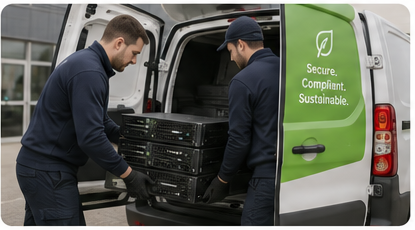
Failing to verify your waste carrier or transfer assets without a valid Waste Transfer Note (WTN) is a criminal offence. It can result in unlimited statutory fines, legal prosecution, and severe brand reputation damage.
Always confirm your collection partner holds an active Upper Tier Waste Carrier Licence. Clearcycle IT is fully registered with the Environment Agency under licence number CBDU646177.
The Duty of Care applies to anyone who imports, produces, carries, keeps, treats, disposes of, or has control of controlled waste. In the context of IT equipment, your company is the "Waste Producer". Under UK law, you cannot contract out of this responsibility. Simply handing your old computers to a local collector or an independent IT contractor does not discharge your legal liability. If that contractor fly-tips the computers or dumps them in an unauthorised landfill, your organisation can be prosecuted alongside the dumper.
To comply with the legislation, you must ensure that waste is only transferred to an authorised person, such as a registered waste carrier, and that a detailed description of the waste is handed over in writing. You must also take all reasonable steps to prevent the escape of the waste while it is under your control, meaning it must be stored in secure containers and protected from the weather to prevent hazardous substances leaking into the ground.
The Environment Agency maintains a public register of all businesses authorised to transport waste. Waste carriers are categorised into Lower Tier (typically carrying their own non-hazardous waste) and Upper Tier (carrying waste for other businesses). Because electrical waste contains hazardous chemicals and components, any provider collecting IT equipment from your business must hold an Upper Tier licence.
Before booking any collection, it is your responsibility to check the Environment Agency public register to verify the provider's licence status. Clearcycle IT operates under licence number CBDU646177. We provide copy documentation of our active carrier licence to all corporate and educational clients prior to dispatch, ensuring your compliance folder is complete.
Every transfer of electrical waste must be accompanied by a Waste Transfer Note. Below is the checklist of required legal details and how Clearcycle IT satisfies them.
| Legal WTN Requirement | Detail Required | Clearcycle IT Implementation |
|---|---|---|
| Waste Description | Type of equipment & EWC Code (e.g. 20 01 36) | Detailed manifest generated automatically |
| Quantity & Containment | Volume, piece counts, and packaging type | Calculated item-by-item on receipt |
| Transferor Details | Your organisation name, address, and SIC code | Pre-populated from booking registration |
| Transferee Details | Carrier details & licence numbers | Clearcycle IT (CBDU646177) prepopulated |
| Signatures & Dates | Dual signatures upon physical collection | Signed digitally or physically on collection day |
When writing a Waste Transfer Note, the waste must be classified using the European Waste Catalogue (EWC) codes. Standard non-hazardous IT equipment (such as modern keyboards, cables, and minor peripherals) is generally classified under code 20 01 36 (discarded electrical and electronic equipment other than those mentioned in 20 01 21, 20 01 23 and 20 01 35).
However, many legacy IT assets contain hazardous elements. Obsolete cathode-ray tube (CRT) monitors, flat-panel displays containing mercury backlights, and batteries from laptops or uninterruptible power supplies (UPS) are classified as hazardous waste under code 20 01 35*. The asterisk denotes that the waste is hazardous. If your collection contains any hazardous items, a standard Waste Transfer Note is not sufficient; instead, a Consignment Note must be generated, and your site must register with the Environment Agency if the volume exceeds certain regional thresholds. Clearcycle IT identifies these classifications during collection planning and prepares the correct paperwork automatically.
Compliance does not end when the collection truck leaves your building. The Environmental Protection (Duty of Care) Regulations require that all waste transfer records be archived. You must keep copy records of all Waste Transfer Notes for at least two years from the date of transfer. If hazardous waste was collected and documented via a Consignment Note, the retention period is extended to three years.
These documents must be stored systematically and made available for inspection by local authorities or Environment Agency officials upon request. Failure to produce these documents during an audit is a strict liability offense. Clearcycle IT operates a digital client portal where all Waste Transfer Notes, Consignment Notes, and Certificates of Destruction are permanently archived, ensuring you can retrieve your records instantly during an inspection.
While compliance is driven by legal mandates, adhering to WEEE regulations offers significant Corporate Social Responsibility (CSR) benefits. Demonstrating a documented, auditable path for your e-waste reinforces your brand reputation as an environmentally responsible business. Many public tenders and private supply chain audits now require proof of compliant ITAD processes.
Clearcycle IT supports your compliance and CSR strategy by issuing detailed environmental recovery statements. We track the weight of materials salvaged from your obsolete hardware and calculate the carbon offset achieved by avoiding manufacturing raw materials. This data can be directly integrated into your annual environmental reporting, proving that your organisation takes its environmental obligations seriously.
Schedule your free collection with Clearcycle IT today and secure your compliant Environment Agency documentation.
