Protect your intellectual property and comply with GDPR. We use professional software wiping and heavy-duty physical shredding to ensure retired storage media is rendered completely unrecoverable.
We employ dual erasure protocols depending on device state, storage medium type, and customer requirements.
Data destruction is the certified permanent sanitisation of storage media to render stored information unrecoverable. The process uses specialized software overwriting, physical crushing, or industrial shredding. UK businesses are legally obligated to protect client data, including employee files, database records, and trade secrets.
Using professional, verified sanitisation workflows prevents corporate information leakage. We run full block-level verification steps for every storage drive, ensuring that no data fragments can be accessed after decommissioning.
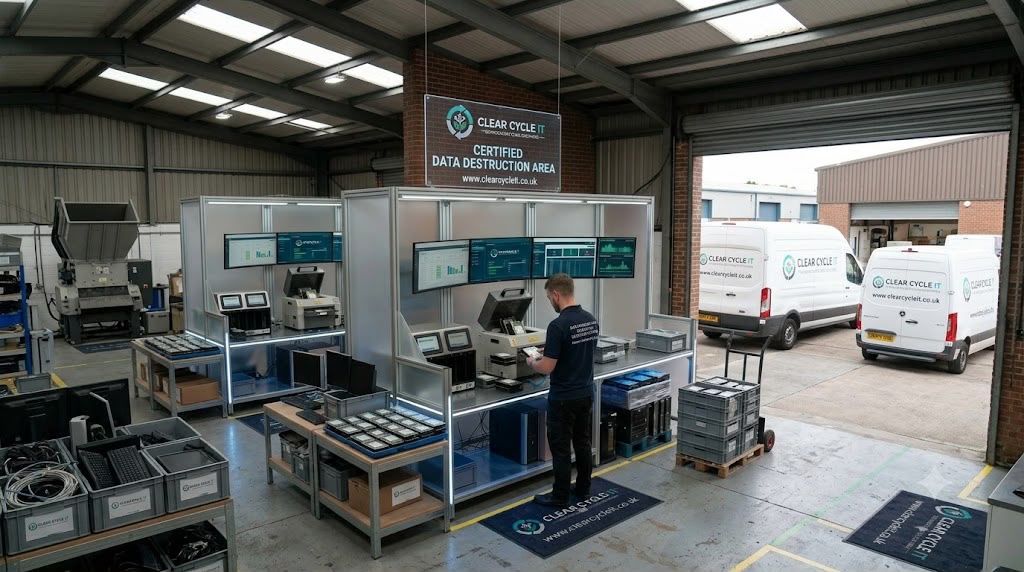
For functional laptops, desktops, and servers, we employ professional sanitisation software. This tool overwrites every sector of the drive with random binary configurations, aligned with NCSC standards. This permits the storage drive to be safely reused without data leakage, backing a circular economy model. Examples of software wiping platforms include Blancco and Certus.
For non-functional drives, legacy magnetic tape, or custom requests, we employ mechanical shredding. Storage drives are crushed and sheared into small metal fragments, making any form of data recovery physically impossible. Shredded metals are then gathered and smelted for recycling. Examples of physical carrier drives include HDDs, SSDs, and optical disks.
We secure your assets from the moment they leave your premises until final data destruction is confirmed.
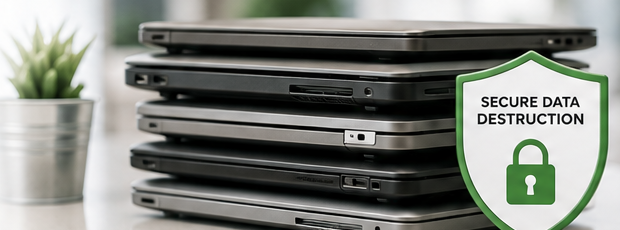
We track every asset using serial numbers to build a legal chain of custody. Our process is fully transparent, allowing data compliance officers to audit the disposal logs easily.
Every storage unit is logged immediately upon arrival at our sanitisation facility, mapping the hardware path from your inventory list to the final sanitisation log.
Collections are performed using our commercial fleet of tracked, secure vehicles. Assets are never left unattended during transit. Examples of secure transport containers include locked steel crates and security-sealed plastic boxes.
All drivers and technicians are background-cleared (DBS checked) and receive ongoing training in information security. Examples of vetting measures include identity verification, criminal records checking, and security clearance logging.
We scan every drive model and serial number. A final Certificate of Destruction is sent to you within 14 days of clearance. Examples of documented fields include drive serial, collection timestamp, and destruction method.


Security is our core priority. From collection to destruction, we maintain a secure chain of custody that exceeds standard government requirements.
Our logistics team collects directly from your site using tracked, secure vehicles. The chain of custody begins the moment we lift the assets.
All members of our collection and destruction teams undergo background checks, providing schools and institutions complete peace of mind.
We use Blancco-level secure software to erase every sector on drives, aligning with the HMG Infosec Standard 5 for data destruction.
Any hard drive or SSD that fails software erasure is physically shredded, rendering data retrieval completely impossible.
You receive a formal Certificate of Destruction listing the serial numbers of all wiped and shredded hard drives for your audit trail.
A full environmental and data compliance report is provided, proving you have met WEEE and GDPR legal obligations.
NIST SP 800-88 Rev 1 defines three levels of sanitisation: Clear (software overwrite), Purge (rendering target data recovery impossible), and Destroy (physical destruction of the media).
UK GDPR and the Data Protection Act 2018 require organizations to enforce strict controls for disposing of personal data. Failing to destroy data permanently can lead to ICO fines of up to £17.5 million. We protect companies from these compliance risks. You are legally responsible for data security until destruction is complete.
Clear uses software tools to overwrite all user-addressable sectors. Purge uses magnetic degaussing or firmware command overwrites. Examples of purge commands include Secure Erase and Sanitize commands. These commands access hidden sectors to remove data carriers. Physical destruction makes read-write functions impossible. Examples of physical destruction methods include shredding, smelting, and disintegrating.
| Sanitisation Method | Target Media Type | Decommissioning Standard | Security Clearance Level |
|---|---|---|---|
| Logical Overwrite | Functional HDDs and SSDs | NIST SP 800-88 Rev 1 (Clear) | Standard Commercial / GDPR |
| Magnetic Degaussing | Magnetic tapes and old HDDs | HMG Infosec Standard 5 (Purge) | High Security / Enterprise |
| Physical Crushing | Damaged magnetic hard drives | HMG Infosec Standard 5 (Destroy) | High Security / Enterprise |
| 2mm Micro-Shredding | Solid-State Drives (SSDs) and smart devices | NIST SP 800-88 & BS EN 15713 | Government / Defense Level |
A Certificate of Data Destruction is a formal compliance document. It confirms that storage media was permanently sanitised. It lists the serial numbers of the devices, the date of processing, and the destruction standards met.
SSDs store data on tiny silicon flash chips. Standard magnetic hard drive shredders break platters but leave these microchips intact. Forensic recovery can read data from whole chips. We shred SSDs to 2mm to pulverise the silicon chips.
Yes. We offer mobile on-site shredding services for high-security environments. Our mobile shredding vehicle grinds hard drives at your facility. This allows your IT managers to witness the destruction before the media leaves your site.
No. Degaussing platters uses strong magnetic fields. SSDs store data electronically on flash transistors, not magnetically. Degaussing has zero effect on SSD data. SSDs must be software overwritten or physically shredded.
Yes. We shred mobile phones, tablet devices, and smart devices. We crush the internal circuit boards and storage chips to prevent any access to cached data. Serialised destruction notes are issued for each smart unit.
Secure your data with Clearcycle IT. We offer certified B2B data disposal across mainland UK. 10 major IT units minimum.
