Evaluating data destruction risk profiles, security compliance paths, and auditing logistics for corporate ITAD.
Last Updated: 29th June 2026
When organisations retire computers, laptops, and servers, data security is the single most critical concern. Under the UK GDPR and Data Protection Act 2018, companies must maintain full custody of data-bearing media until it is fully destroyed or sanitised. Choosing between on-site drive crushing and secure off-site shredding has significant implications for your compliance audit trail.
Both methods are compliant when executed by certified ITAD partners, but the logistics, verification processes, and risk profiles differ substantially. Below, we break down these differences to help you select the appropriate service for your team.
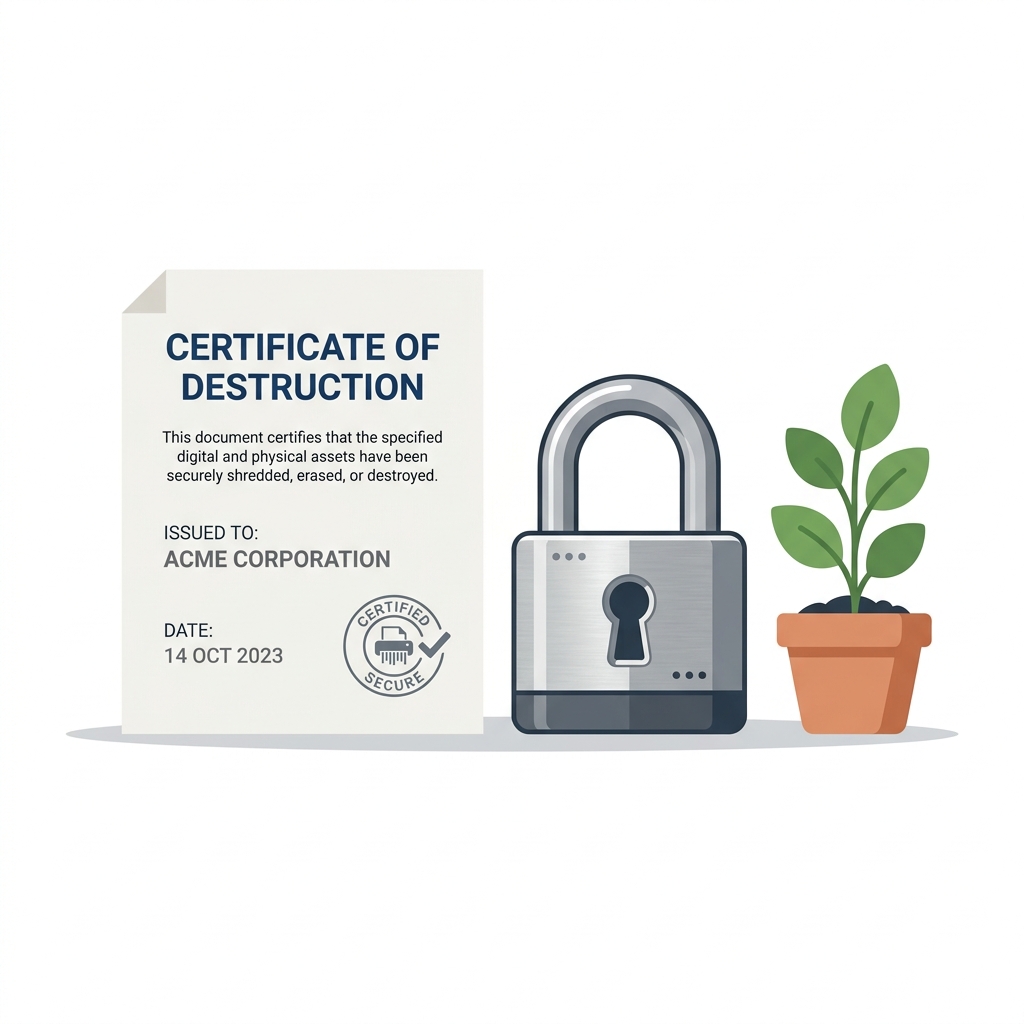
Before analyzing disposal methods, it is important to understand the standards governing data destruction. In the UK, the standard for data sanitisation was traditionally set by the HMG InfoSec Standard No. 5 (often referred to as HMG IS5). Modern frameworks also reference the NIST SP 800-88 Rev. 1 Guidelines for Media Sanitisation, which define three levels of data erasure: Clearing (software overwriting), Purging (degaussing or low-level formatting), and Destroying (physical disintegration, incineration, or shredding).
For solid-state drives (SSDs), physical shredding must reduce the media to a particle size of 2mm to 9mm depending on the classification level, as SSD memory chips store data in high density. Traditional magnetic hard disk drives (HDDs) can be shredded to larger sizes, but they must still be completely mangled to prevent the recovery of platters. Understanding these requirements helps contextualise why physical destruction is the preferred choice for legacy drives.
| Feature | On-Site Destruction | Off-Site Shredding |
|---|---|---|
| Execution Location | Your office premises / loading bay | Clearcycle IT secure processing facility |
| Transit Risk | Zero Risk (data destroyed before travel) | Low Risk (secure locked bins + GPS tracking) |
| Physical Verification | Witnessed live by your security team | Recorded via CCTV and automated barcode logs |
| Certificate Timeline | Issued immediately post-crush | Digitally issued within 14 days of receipt |
| Cost Efficiency | Premium (setup and vehicle dispatch costs) | Highly Cost-Effective (included in collections) |
By destroying media before it leaves your loading bay, you eliminate chain-of-custody leaks entirely. This is essential for financial offices, health records custodians, and government organisations.
Our secure transit vehicles and GPS logging ensure safe delivery to our plant. This offers the best balance of cost and compliance for schools, colleges, and standard commercial clearance.
On-site drive destruction involves dispatching a specialised mobile shredding vehicle to your location. These vehicles are equipped with industrial-grade shredders powered by onboard generators. Our engineers bring the hard drives or tape media directly to the vehicle, where they are scanned and fed into the shredding mechanism. Representatives from your IT or security department are encouraged to witness the process firsthand.
This method offers immediate closure. As soon as the drives pass through the cutter heads, the data ceases to exist in an accessible form. The operator issues a Certificate of Destruction detailing the serial numbers of the processed drives before the vehicle leaves the premises. The primary drawback is cost, as mobilising heavy equipment and specialised personnel carries a premium setup fee.
Off-site shredding leverages the economy of scale provided by central processing plants. The process begins with our DBS-checked team packing your drives into secure, numbered wheelie bins, which are sealed with tamper-evident tags. These bins are loaded onto GPS-tracked vehicles and transported directly to our recycling facility.
Once at the plant, the bins are opened in a secure zone under 24/7 CCTV surveillance. Every drive is scanned by its barcode or serial number, cross-referenced with the collection manifest, and then fed into a high-capacity industrial shredder. The shredded remnants are collected, separated by material type, and prepared for smelting. Within 14 days, a digital audit trail and Certificate of Destruction are emailed to you, closing the loop. Off-site shredding is significantly more economical, as the processing costs are distributed across multiple client collections.
Under GDPR, your organisation remains the data controller until the data is destroyed. If you choose off-site shredding, you are delegating the transit of active data. This introduces a transit risk. Although rare, vehicle accidents, theft, or administrative logging errors can occur. To mitigate this risk, Clearcycle IT utilizes locked steel cages, real-time vehicle tracking, and double-signature handovers.
For organisations with strict risk policies, even a minute chance of transit loss is unacceptable. On-site shredding neutralises transit risk by converting the active data-bearing media into harmless scrap metal prior to transportation. The material transported is classified as non-hazardous waste rather than sensitive personal data, shifting the risk profile to zero.
Regardless of where the shredding takes place, the resulting material must be handled in accordance with the UK WEEE (Waste Electrical and Electronic Equipment) Regulations. The shredded scrap consists of aluminium casings, steel platters, copper cabling, and circuit boards containing precious metals like gold and silver.
Clearcycle IT operates a 0% landfill policy. All shredded output is sent to authorised UK refining partners who use magnetic separation and smelting processes to reclaim raw metals. These metals are returned to the manufacturing supply chain, reducing the environmental footprint of producing new electronics. We provide environmental waste transfer notes alongside destruction certificates, allowing you to demonstrate compliance with both data security and environmental legislation.
When deciding between these two services, consider the following checklist:
Speak with one of our local B2B ITAD specialists about booking an on-site crushing collection or a secure off-site recycling schedule.
